Prison Act, Section 50: enforced solitary confinement
Three SecondsPrison Act, Section 50: enforced solitary confinement is a measure imposed by prison authorities, not a form of separation a prisoner can simply elect. In Piet Hoffmann’s case, the distinction between an inmate’s right to request voluntary isolation and the administration’s power to enforce solitary confinement becomes a question of survival: moving him away from one unit does not, by itself, keep other prisoners from reaching him.
The rule and its threshold
The prison official explains that voluntary isolation and solitary confinement operate under different provisions and conditions. Hoffmann has been moved to a voluntary isolation unit under Section 18 at his own request; the prison is required to honor that request. Section 50, by contrast, is not available at an inmate’s discretion. It is an enforced decision made by a principal officer in the unit or by the official speaking with Hoffmann.
The stated threshold is danger: a prisoner must be considered a danger to someone else or to himself. The official specifies violence toward fellow prisoners or toward staff as the kind of danger that could justify the measure. The explanation defines both who may decide and what grounds the prison recognizes. Hoffmann asks how the decision is made and what counts as danger, but the passage does not establish that an order under Section 50 is actually issued to him.
Voluntary separation is not the hole
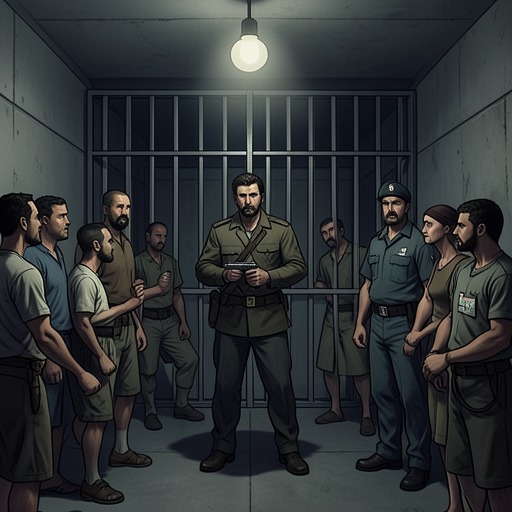
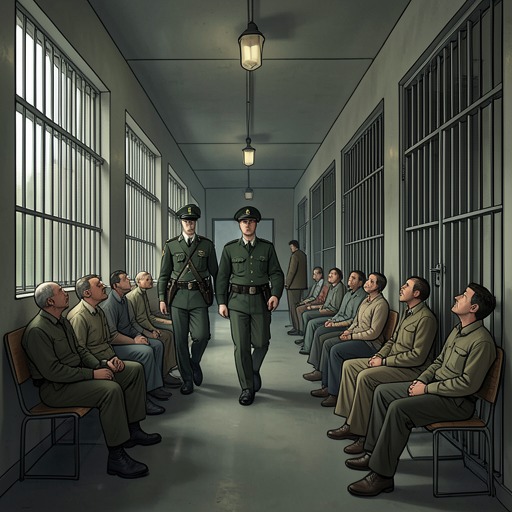
The difference is made concrete by Hoffmann’s location. After learning that he may be exposed, he asks to be put in the hole and says that he wants no contact with other prisoners. The request has brought him to Block C, but the voluntary unit is not the same as solitary confinement. It has sixteen cells, a wardens’ room, a television corner, showers, a kitchen, and a ping-pong table. Residents can move around within it, even though they are kept apart from prisoners in other units.
That arrangement offers separation by unit, not isolation from everyone inside it. Hoffmann looks through the open door and sees that the prisoners there can move freely. He understands that the transfer has not removed the danger: he has been moved away from one group, not beyond the reach of other inmates altogether. His fear that he will not survive the week in the unit gives the legal distinction immediate practical force. The hole would mean a further, more restrictive form of separation, but Section 50 leaves the decision in the hands of prison officials.
The danger behind the request
The threat is connected to the collapse of Hoffmann’s undercover position. In the prison’s ordinary unit, he had used calculated conduct to establish a visible place for himself: he sat where the returning prisoners would see him, took a familiar chair and marked cards, and began a game without asking permission. He had studied the other inmates’ backgrounds and relied on Stefan Lygas and Karol Tomasz Penderecki as allies in taking over the prison drug market. Their assistance included arranging access to copies of records about him, obtained through Stefan’s lawyer.
That apparent protection turns precarious when Hoffmann realizes that someone has exposed him. He concludes that one of the four men he had counted on has betrayed him, and prisoners begin whispering the word associated with an informant. The voluntary transfer therefore answers only one part of his predicament: it moves him out of Block G, while leaving him among other prisoners and unable to determine what they know. Section 50 matters to him not as an abstract regulation but as a possible way to escape contact with people who may now see him as a target.
The prison’s controlled spaces
The contrast between Sections 18 and 50 belongs to a wider pattern of regulated movement in Aspsås Prison. On arrival, Hoffmann is processed through a security entrance, issued prison clothes, and left in a sterile waiting room. After ten days, he has spent twenty-three hours a day in a cell behind a metal door, with no visitors, newspapers, television, or radio. Later, a principal officer gives him a tour of the unit, explaining its daily routines and the timing of lock-in. These details show a system that controls not only where a prisoner may go but also how his time and contact with others are organized.
The move to voluntary isolation is similarly controlled. A ten-person prison riot squad enters Block G: six remain there to deter renewed violence, while four escort Hoffmann through the prison to the unit in Block C. The escort is protective in purpose, but it also makes plain that the prison determines the routes, boundaries, and conditions of his separation. Within that system, Section 50 marks a further boundary—one established by an official judgment of danger rather than by the prisoner’s request.
Significance and limits
Hoffmann’s appeal exposes the gap between formal protection and actual safety. The prison honors his request for voluntary isolation, yet the unit’s shared spaces leave him among people he fears. Section 50 offers a more complete form of separation only if the authorities decide that its threshold has been met; his own assessment that he is in danger is not enough to compel that decision. The rule thus places the crucial judgment outside his control at the precise moment when he most wants control over who can reach him.
The passage presents the provision through its practical distinction from Section 18, rather than as a general account of the law. It establishes the official grounds and decision-makers described to Hoffmann, and shows why he presses for the more restrictive measure. It does not show that officials grant his request, nor does it establish that he commits violence in order to qualify. What it does establish is the precariousness of the voluntary unit: Hoffmann can ask to be separated, but he cannot decide that the prison must put him in the hole.